01
1.56
STANDARD INDEX
A practical choice for everyday prescriptions.
A standard index option for everyday prescription requirements where extreme lens thinness is not the primary consideration.
↗
Higher index lenses allow the required prescription power to be achieved with a thinner lens design. But which index is right for you?
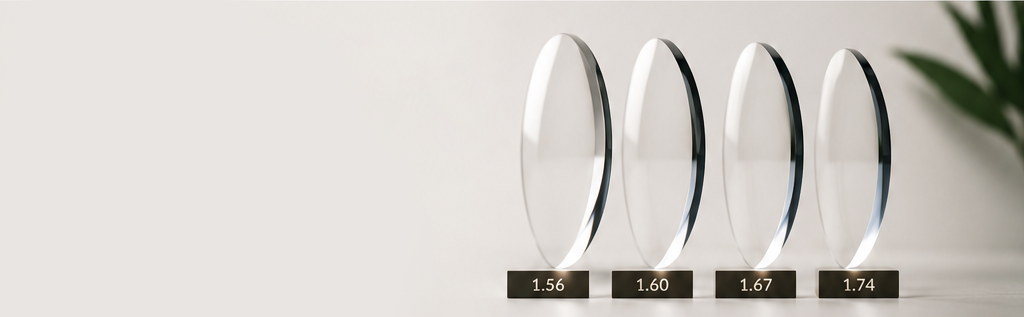
Choosing prescription lenses is about more than finding the correct power. The lens index can also influence the thickness and overall appearance of your finished lenses.
Lens index describes how efficiently a lens material bends light. A higher index can allow the required prescription power to be achieved with less lens material.
When prescription power increases, lens thickness can become an important consideration. Higher-index options can help achieve the required optical power with a thinner lens profile.
The ideal choice depends on your prescription, frame selection and individual visual requirements.
The ideal lens index depends on your prescription, frame and personal requirements. Explore the differences between the available Osten index options.
A standard index option for everyday prescription requirements where extreme lens thinness is not the primary consideration.
A higher-index option to consider when a thinner lens profile is more important for your prescription and frame choice.
A higher-index solution that can help achieve the required optical power with a thinner lens profile.
The highest index option in the Osten range, intended for prescriptions where lens thickness and appearance are important considerations.
The highest index is not automatically the best choice. Your prescription, frame and individual requirements should always guide the final selection.
One of the key reasons to consider a higher-index lens is the potential for a thinner lens profile, particularly when prescription strength increases.
More lens material may be required to achieve the same optical power.
A higher index can achieve the required prescription with less lens material.
A thinner profile can contribute to a more refined appearance, depending on your prescription and frame.
A few things worth knowing before choosing your next pair of prescription lenses.
High-index lenses use lens materials that can achieve the required prescription power with less material. This can help create a thinner lens profile, particularly for stronger prescriptions.
Not necessarily. The most suitable lens index depends on your prescription, frame selection and individual visual requirements. The highest index is not automatically the right choice for everyone.
Your prescription and chosen frame should be considered together when selecting an index. An optical professional can recommend the most appropriate option for your needs.
A higher index can allow the required optical power to be achieved with less lens material, which can contribute to a thinner lens profile.
Yes. Frame size and shape can influence the final appearance of a prescription lens. Lens index and frame selection are therefore best considered together.
Depending on your requirements, lens features can include UV protection, scratch resistance, water repellency, lightweight comfort and easy-clean properties.